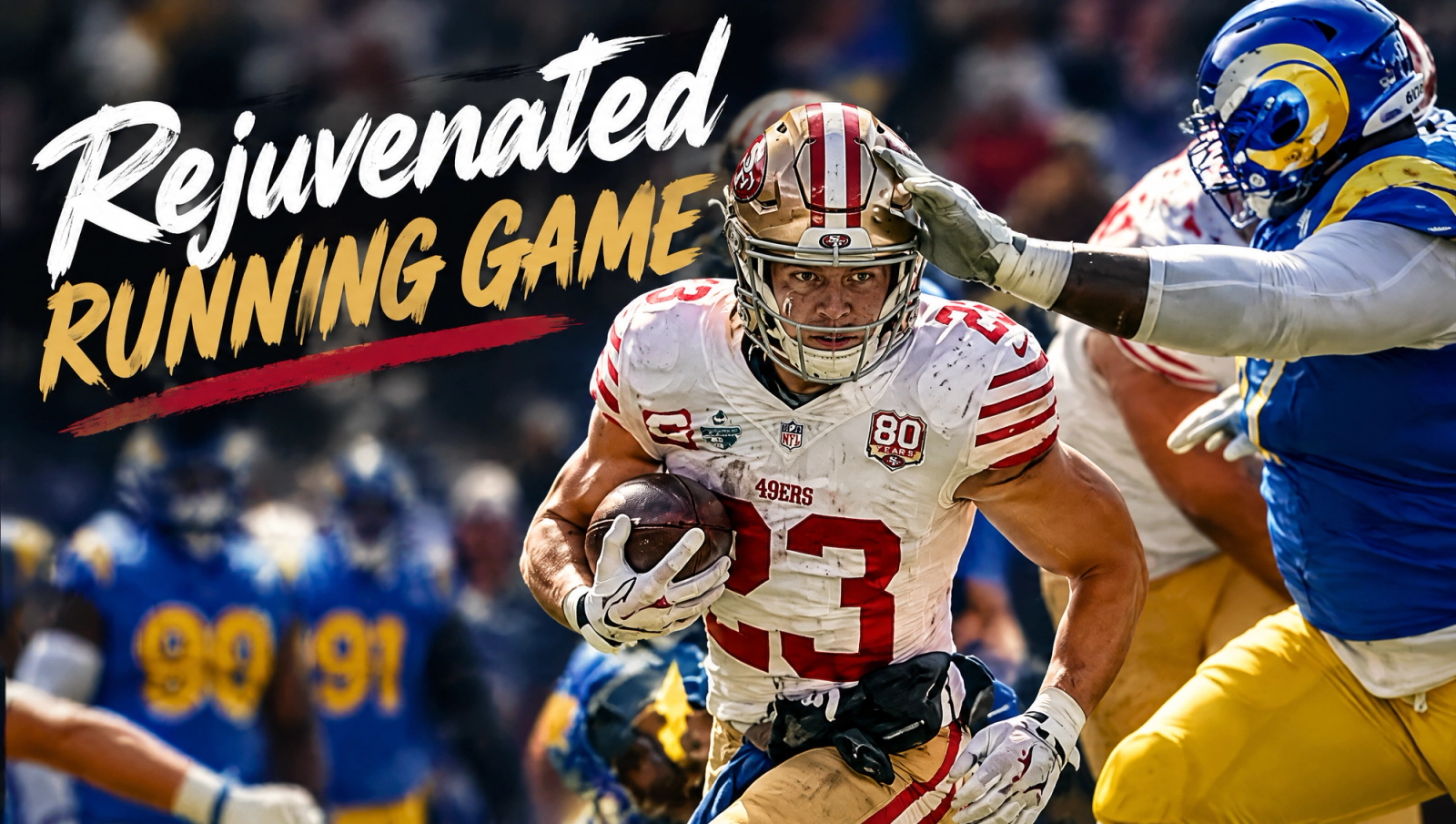
The 49ers did not merely run the ball well against the Rams. They made the run game look connected again.
San Francisco finished its 27–7 Week 1 win in Melbourne with 174 rushing yards on 30 attempts. Christian McCaffrey averaged 6.8 yards per carry. Rookie Kaelon Black handled more carries than McCaffrey. Kyle Juszczyk spent half his night moving before the snap, turning a familiar fullback role into the engine of the operation.
One game cannot certify a season-long revival. But this was more than a few favorable bounces. Kyle Shanahan showed a structural answer to the problems that dragged down the ground game in 2025: create momentum before contact, disguise the point of attack and spread the workload without taking the offense away from McCaffrey.
This Was More Than a Good Box Score
The clean numbers jump out first. San Francisco averaged 5.9 yards per rush and produced a 56.7 percent rushing success rate, the best mark in the league after Week 1. The 49ers gained positive expected points on the ground instead of living on one or two breakaway runs.
That distinction matters. A rushing attack can finish with a healthy average because one explosive play hides a pile of failed attempts. Success rate measures whether the offense repeatedly stays ahead of the defense. Against Los Angeles, the 49ers kept creating manageable situations and forcing the Rams to defend the next answer.
The opponent deserves to be part of the evaluation. Los Angeles stayed in nickel personnel for much of the game, and San Francisco punished that lighter box. The Standard charted the 49ers at 6.5 yards per carry against nickel. Future opponents will not be as patient while the line moves defensive backs and smaller bodies off the ball.
Still, the way San Francisco created those gains is transferable. The motion can travel. The blocking angles can travel. A second back capable of taking real work can travel.
Juszczyk Turned Motion Into Force
Motion has been part of Shanahan's offense for years, so simply saying the 49ers used more of it misses the point. The important change was how aggressively they tied motion to the run game.
Next Gen Stats tracked a player moving at the snap on 65.6 percent of all 49ers offensive plays, the highest rate of the Shanahan era. The Athletic Football Show's film breakdown charted motion at the snap on 75 percent of San Francisco's runs, up from 47.5 percent in 2025.
Juszczyk was the center of it. He was moving at the snap on 17 of his 33 plays; no other 49er did so more than five times.
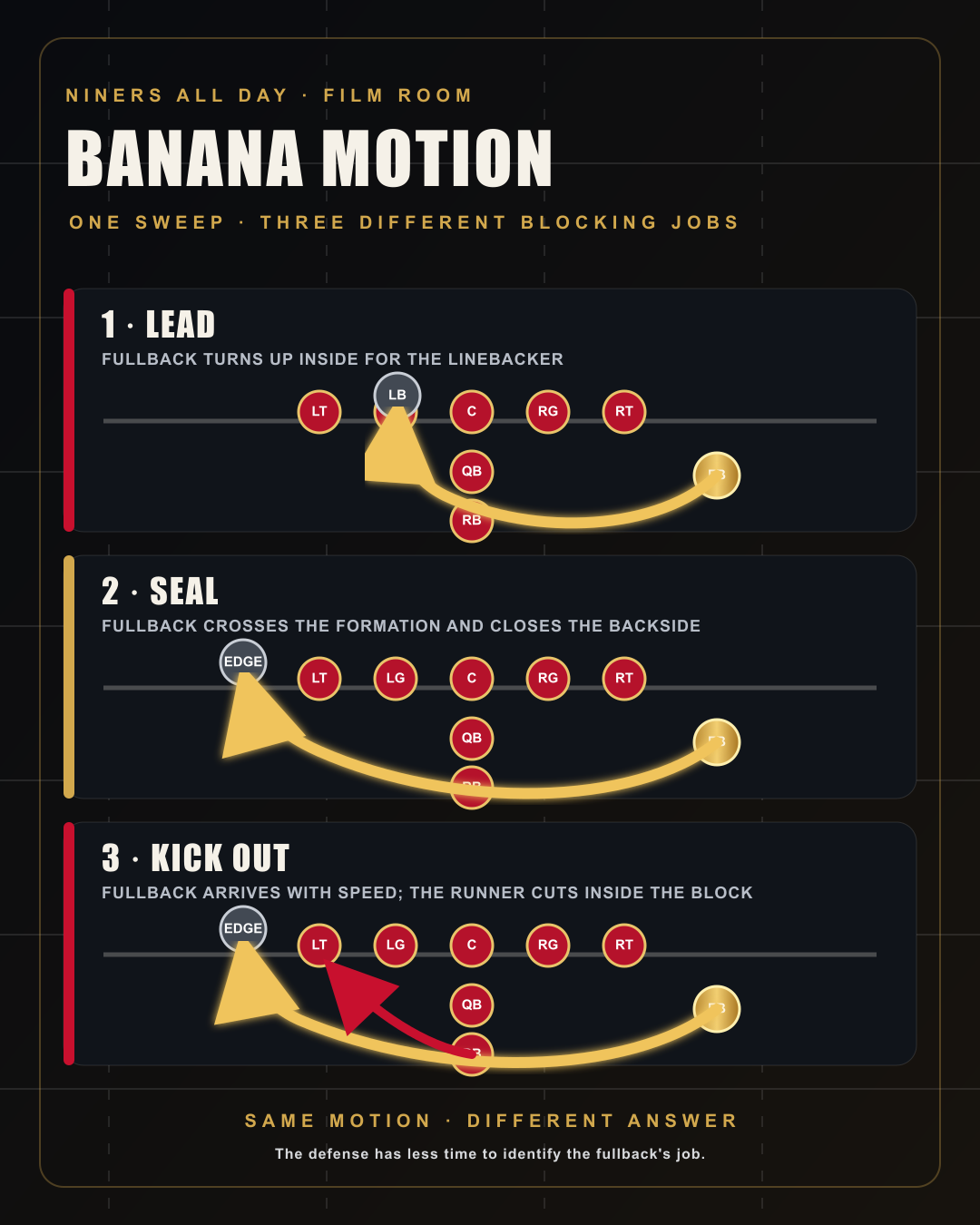
The curved banana path gave him a running start behind the formation before he turned downhill. That extra momentum changes the collision. Instead of asking a stationary fullback to locate a defender and generate force from a short distance, the design lets Juszczyk arrive with speed and a better angle.
It also steals recognition time from the defense. A linebacker cannot fully commit when the same moving fullback might lead through the front side, seal the back side or kick out an edge defender on counter. The picture starts the same. The job changes late.
One Motion, Several Answers
The best run schemes do not win because one play is unstoppable. They win because the defense cannot be certain which version is coming.
On one snap, Juszczyk can lead directly onto an off-ball linebacker. On another, he can cross the formation and seal the end man away from the run. The spicier answer against Los Angeles was a counter look that sent him toward the edge for a kick-out block while the ball hit behind him.
That multiplicity forces defenders to hesitate, bump gaps or communicate while the ball is being snapped. A half-second of uncertainty is enough for an offensive lineman to gain leverage. It is enough for a tight end to climb cleanly to the second level. It is enough for McCaffrey or Black to reach daylight before the pursuit settles.
The real stress comes from pairing those runs with San Francisco's passing game. If a defense starts overplaying the motion, Shanahan can release the moving player, leak a tight end behind the adjustment or throw into the space a linebacker just abandoned. The run action does not need to produce a handoff to affect the defense.
The Line Made the Geometry Matter
Motion can create a clean picture, but somebody still has to move another large human being. Week 1 offered encouraging evidence there, too.
The Athletic's breakdown highlighted a rep where left guard Connor Colby and left tackle Trent Williams displaced a defensive tackle across the formation before climbing toward the back-side linebacker. That movement created space for tight end Luke Farrell to lead onto the play-side linebacker, springing McCaffrey for a 14-yard gain.
That is the version of the 49ers run game Shanahan has always chased: not necessarily overpowering every defender straight ahead, but arranging the angles so each blocker can arrive with an advantage.
Colby is especially important to that equation. He played meaningful snaps as a seventh-round rookie in 2025. If his Week 1 physicality holds up, San Francisco may have found more than a functional left guard. It may have found the interior movement that lets the entire design breathe.
The early result was a line that looked faster because it played with more force—and more forceful because the scheme let it play faster.
Kaelon Black Changes the McCaffrey Equation
The most jarring number in the box score was not a rushing average. It was the carry split.
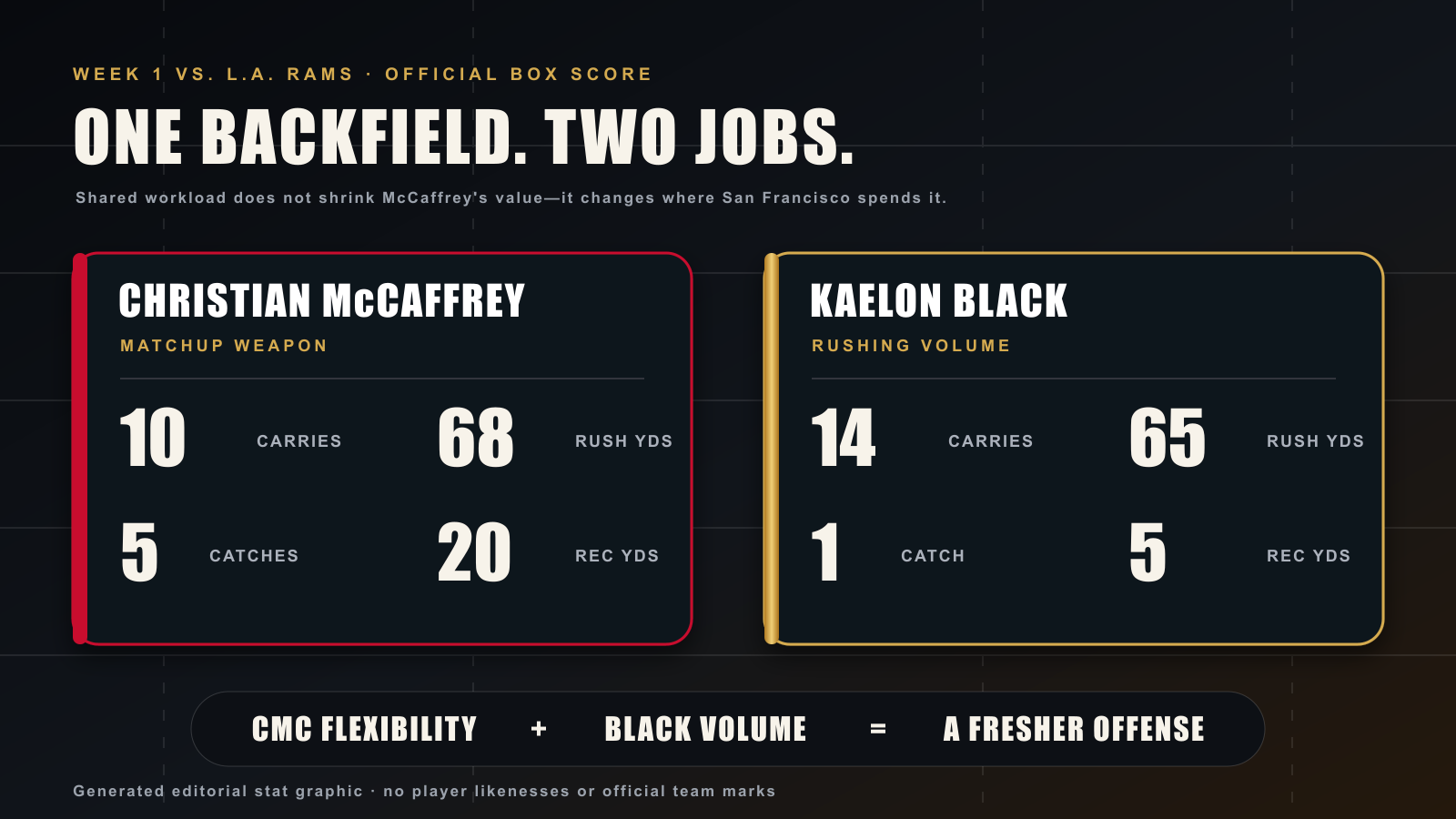
Black had 14 carries for 65 yards. McCaffrey had 10 carries for 68 yards, then added five receptions for 20 yards. It was the first time since McCaffrey joined the 49ers that a healthy teammate clearly out-carried him in a full game.
That should not be read as a demotion. It is a better allocation of a 30-year-old star.
McCaffrey remains the offense's most flexible matchup piece. His receiving ability can force a linebacker into space, pull a safety out of structure or empty the box before the snap. Asking him to absorb every routine interior carry can reduce the very advantage that makes him special.
Black gives Shanahan another credible answer. The rookie ran with visible acceleration and enough decisiveness to keep the offense on schedule. If defenses have to respect him as more than a change-of-pace cameo, McCaffrey can spend more snaps attacking favorable coverage instead of carrying the entire rushing burden.
What Defenses Will Try Next
The Rams gave San Francisco a light box and paid for it. The next defense may respond with heavier personnel, tighter edges and more aggressive exchanges when Juszczyk begins his sweep.
Edge defenders can attack the kick-out block instead of accepting it. Linebackers can bump with the motion and force the ball back toward help. Safeties can trigger downhill earlier. Coordinators can also disguise those adjustments, hoping Purdy checks into the wrong answer.
That is where this concept becomes a season-long story. Can the 49ers punish a heavier box through the air? Can they run away from a defense that over-rotates with Juszczyk? Can Black maintain his efficiency when opponents treat him as a real part of the plan?
San Francisco does not need the Week 1 percentages to repeat exactly. It needs the cause-and-effect relationship to remain intact: motion creates hesitation, hesitation creates angles and the backs turn those angles into efficient gains.
The 49ers' ground game looked supercharged because every layer amplified the next one.
Juszczyk's movement created force and disguise. Colby, Williams and Farrell converted those advantages into displacement. Black supplied fresh speed and a credible second workload. McCaffrey remained efficient without being asked to carry the entire operation.
That is a much healthier formula than hoping one star rescues every run.
Week 1 was proof of concept, not proof of permanence. But after a year in which San Francisco's run game too often felt ordinary, the offense once again made defenders solve problems before and after the snap. That is the version of Shanahan football the rest of the league has spent years trying to copy—and the version the 49ers just pushed forward again.
For more 49ers analysis with a fan-first angle, follow Niners All Day.